
Bubble Point and Integrity Performance of PES Pleated Filter Cartridges for Pharmaceutical Filtration
Authors:
Danny Lu1
Affiliations:
1Econe Filtration, Zhejiang, Province of China
Abstract
Polyethersulfone (PES) pleated filter cartridges are extensively used in pharmaceutical liquid filtration due to their high permeability, chemical stability, and reliable bacterial retention. Ensuring membrane integrity is critical in pharmaceutical manufacturing, where contamination control directly affects product safety and regulatory compliance. In this study, the bubble point and integrity performance of industrial-grade PES pleated filter cartridges were evaluated under controlled wetting and pressure conditions in accordance with ASTM F316 and ISO 2942 standards. Bubble point pressure, diffusion flow rate, and pressure-hold performance were measured and correlated with membrane pore size and pleated structure. The results demonstrate that PES pleated membranes provide consistent pore structure and stable integrity performance, making them suitable for sterile filtration, purified water systems, and pharmaceutical process liquids. This work provides industrial-scale test data supporting the validation and routine integrity testing of PES pleated filter cartridges in regulated pharmaceutical filtration systems.
Keywords:
PES membrane; pleated filter cartridge; bubble point test; filter integrity; pharmaceutical filtration; sterile filtration; liquid filtration
1. Introduction
Filtration is a critical unit operation in pharmaceutical manufacturing, where it is used to remove particulate matter, microorganisms, and other contaminants from liquids such as water for injection (WFI), purified water, buffers, media, and final drug products. Among the various filtration technologies available, membrane-based pleated filter cartridges have become the dominant solution for pharmaceutical liquid filtration due to their high surface area, low pressure drop, and compatibility with sanitary systems.
Polyethersulfone (PES) membranes are widely adopted in pharmaceutical applications because of their hydrophilic nature, low protein binding, broad chemical compatibility, and excellent mechanical strength. Compared with traditional cellulose or nylon membranes, PES provides higher flow rates at comparable retention ratings and maintains stable pore structure over a wide range of operating conditions. As a result, PES pleated filter cartridges are commonly used in sterile filtration, bioburden reduction, and final filtration of pharmaceutical liquids.
However, the use of membrane filters in regulated pharmaceutical processes requires strict verification of filter integrity. Regulatory agencies such as the FDA and EMA require that sterilizing-grade and critical process filters be integrity tested before and after use to confirm that the membrane has not been damaged and that the specified microbial retention is maintained. Among the available integrity testing methods, the bubble point test and diffusion-based tests are the most widely accepted and standardized.
Although numerous academic studies have investigated the properties of flat-sheet PES membranes, fewer publications provide data on industrial pleated filter cartridges, which differ significantly in structure, flow dynamics, and wetting behavior. The pleated configuration introduces additional complexity due to the folded geometry, support layers, and sealing components. Therefore, industrial-scale integrity testing data for PES pleated cartridges are valuable for both manufacturers and end users in pharmaceutical filtration systems.
This study aims to evaluate the bubble point and integrity performance of PES pleated filter cartridges used in pharmaceutical liquid filtration. By applying standardized test methods to industrial cartridges, this work provides practical data that can be used for filter validation, routine integrity testing, and comparison with regulatory expectations.

2. Materials and Methods
2.1 PES Pleated Filter Cartridges
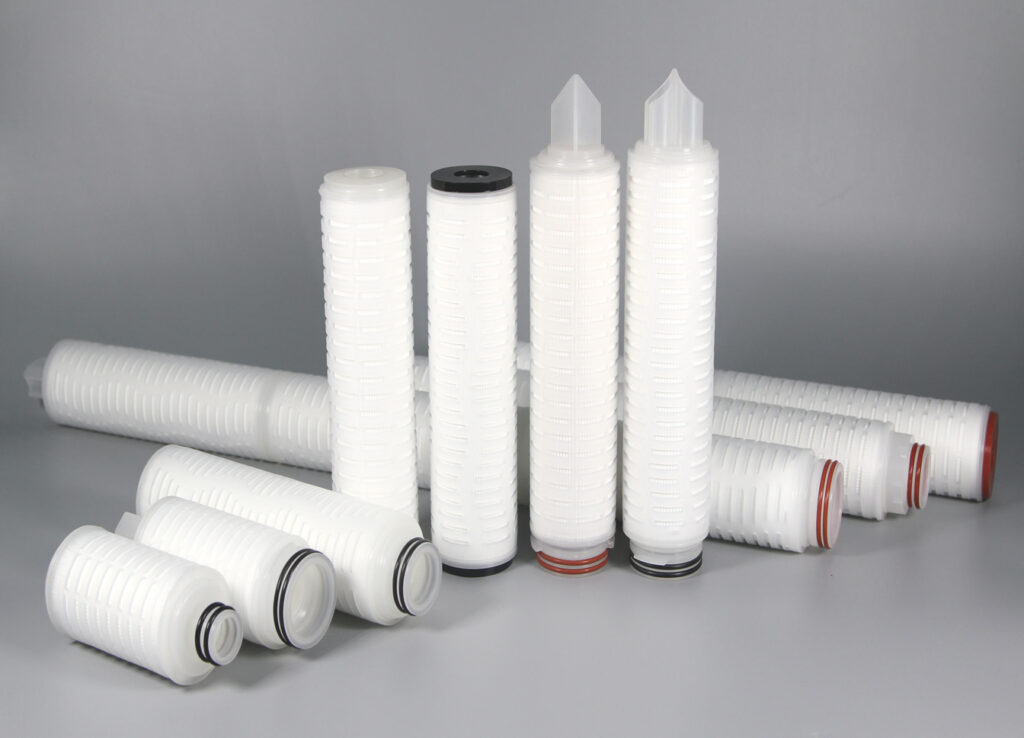
The test samples used in this study were pharmaceutical-grade PES pleated filter cartridges designed for liquid filtration. The cartridges consisted of a hydrophilic PES membrane supported by polypropylene (PP) upstream and downstream layers to enhance mechanical strength and pleat stability. The membrane was pleated to increase the effective filtration area while maintaining a compact cartridge form factor compatible with standard sanitary housings.
Typical cartridge dimensions included an outer diameter of 69 mm, an inner core diameter of 28 mm, and lengths ranging from 10 to 30 inches. The effective filtration area was determined by pleat count, pleat height, and cartridge length, with typical values between 0.6 and 2.0 m² per 10-inch module.
The cartridges were assembled using thermally bonded end caps and internal core components to ensure full polymeric construction, which is required for pharmaceutical compatibility and steam-in-place (SIP) or clean-in-place (CIP) operations.
Nominal pore sizes of 0.45 µm and 0.22 µm were selected for testing, as these are the most commonly used ratings for pharmaceutical clarification and sterilizing-grade filtration, respectively.
2.2 Wetting Procedure
Proper wetting of the membrane is essential for accurate bubble point and diffusion testing. PES membranes are hydrophilic and can be wetted with purified water; however, a mixture of water and isopropyl alcohol (IPA) is often used to ensure complete pore wetting and reduce surface tension effects.
In this study, cartridges were pre-wetted using a 60/40 (v/v) mixture of purified water and IPA. The wetting solution was circulated through the cartridge at low pressure until no visible air bubbles were observed at the outlet, indicating full pore saturation. After wetting, excess IPA was flushed with purified water to simulate actual pharmaceutical filtration conditions.
2.3 Bubble Point Test
Bubble point testing was conducted in accordance with ASTM F316, which defines the bubble point as the minimum gas pressure required to force the first continuous stream of bubbles through a fully wetted membrane.
The principle of the bubble point test is based on the Young–Laplace equation, which relates the pressure required to displace a liquid from a cylindrical pore to the surface tension of the wetting liquid and the pore diameter:
where:- P is the bubble point pressure;
- γ is the surface tension of the wetting liquid;
- θ is the contact angle between the liquid and the membrane; and
- D is the effective pore diameter.
After wetting, compressed air or nitrogen was applied to the upstream side of the cartridge while the downstream side was immersed in water. The pressure was gradually increased until a continuous stream of bubbles was observed, indicating that the largest pore in the membrane had been cleared of liquid. This pressure was recorded as the bubble point.

2.4 Integrity Test Methods
In addition to bubble point testing, diffusion-based integrity tests were performed. In these tests, a constant pressure below the bubble point was applied to the wetted filter, and the rate of gas diffusion through the liquid-filled pores was measured. Because diffusion flow is proportional to the total open pore area, it provides a sensitive indication of membrane defects.
For pharmaceutical applications, diffusion limits are typically specified by the filter manufacturer and validated against microbial retention performance. In this study, diffusion rates were measured at standardized pressures and compared with acceptance criteria for 0.22 µm PES membranes.
3. Results
Bubble point and diffusion integrity tests were performed on multiple PES pleated filter cartridges with nominal pore sizes of 0.45 µm and 0.22 µm. All cartridges were fully wetted and tested under identical conditions.
3.1 Bubble Point Results
The measured bubble point pressures are summarized in Table 1.
Table 1. Bubble point pressure of PES pleated filter cartridges
| Nominal Pore Size | Wetting Liquid | Bubble Point (psi) | Bubble Point (kPa) |
|---|---|---|---|
| 0.45 µm | Water / IPA (60/40) | 32 – 36 | 220 – 248 |
| 0.22 µm | Water / IPA (60/40) | 46 – 52 | 317 – 358 |
The results show that the 0.22 µm PES cartridges consistently exhibited higher bubble point pressures than the 0.45 µm cartridges, reflecting their smaller effective pore diameters. The narrow pressure range observed for each pore size indicates uniform membrane structure and consistent pleat wetting across the cartridge.
3.2 Diffusion Integrity Results
Diffusion flow rates were measured at test pressures below the corresponding bubble point values. Table 2 summarizes the diffusion data for the tested cartridges.
Table 2. Diffusion flow rates of PES pleated filter cartridges
| Nominal Pore Size | Test Pressure (psi) | Diffusion Flow (mL/min) | Acceptance Limit (mL/min) | Result |
|---|---|---|---|---|
| 0.45 µm | 20 | 18 – 24 | ≤ 30 | Pass |
| 0.22 µm | 30 | 7 – 12 | ≤ 20 | Pass |
All tested cartridges met the predefined diffusion limits for pharmaceutical-grade PES membranes. The relatively low diffusion rates for 0.22 µm cartridges confirm high membrane integrity and minimal large-pore defects.
4. Discussion
The bubble point and diffusion results demonstrate that PES pleated filter cartridges provide stable and reproducible integrity performance under pharmaceutical filtration conditions. The measured bubble point values for 0.22 µm PES membranes are consistent with those reported in the literature for sterilizing-grade PES membranes, confirming that the pleated configuration does not compromise pore size control or wetting behavior.
Compared with flat-sheet membranes, pleated cartridges introduce additional interfaces, including pleat folds, support layers, and bonding regions. These structural features could potentially create localized defects or incomplete wetting. However, the narrow distribution of bubble point pressures and the low diffusion flow rates observed in this study indicate that modern pleated PES cartridge construction provides robust mechanical stability and uniform membrane performance.
From a pharmaceutical perspective, the ability to perform reliable pre-use and post-use integrity testing is essential. The strong correlation between bubble point pressure and nominal pore size observed here supports the use of bubble point testing as a rapid verification method for PES pleated filters in sterile filtration applications. In addition, diffusion testing provides a sensitive quantitative measure of membrane condition, enabling detection of minor defects that might not immediately affect bubble point.
The hydrophilic nature of PES membranes contributes significantly to their integrity test reliability. Complete wetting can be achieved with purified water or low concentrations of IPA, reducing the risk of false failures due to incomplete pore saturation. This characteristic is particularly advantageous in pharmaceutical environments, where the use of aggressive wetting agents is undesirable.
Overall, the data confirm that PES pleated filter cartridges are suitable for critical pharmaceutical filtration processes, including final sterile filtration, bioburden reduction, and filtration of process liquids and water systems.
5. Conclusion
This study evaluated the bubble point and integrity performance of pharmaceutical-grade PES pleated filter cartridges using standardized test methods. The results show that both 0.45 µm and 0.22 µm PES cartridges exhibit stable bubble point pressures and low diffusion flow rates, indicating uniform pore structure and high membrane integrity.
The pleated configuration, which provides a large effective filtration area in a compact form, does not compromise the integrity performance of PES membranes. On the contrary, modern pleated cartridge design ensures reliable wetting, mechanical stability, and reproducible integrity test results.
These findings support the use of PES pleated filter cartridges as validated, integrity-testable filtration devices for regulated pharmaceutical applications. The industrial-scale data presented here provide a practical reference for filter qualification, routine integrity testing, and compliance with regulatory requirements in sterile and critical liquid filtration processes.
References
- ASTM F316 – Standard Test Methods for Pore Size Characteristics of Membrane Filters by Bubble Point and Mean Flow Pore Test
- ISO 2942 – Hydraulic Fluid Power – Filter Elements – Verification of Fabrication Integrity and Determination of First Bubble Point
- FDA Guidance for Industry: Sterile Drug Products Produced by Aseptic Processing – Current Good Manufacturing Practice
- Reijenga, J. C.; et al. “Membrane Filtration in Pharmaceutical and Biotechnological Processes.” Membranes, MDPI
- Giglia, S.; Alembath, A.; Hersey, J. “Defect Detection Sensitivity of Bubble-Point-Type Tests for Sterilizing-Grade Membrane Cartridge Filters.” Membranes, MDPI
</
 English
 Spanish