
High Flow Filter Cartridge Selection Guide: Flow & Micron Rating
INTRODUCTION
Selecting the right high flow filter cartridge is one of the most critical decisions when designing or upgrading an industrial filtration system. Flow rate and micron rating directly affect filtration efficiency, system stability, operating costs, and overall equipment lifespan. An incorrect choice may result in excessive pressure drop, premature cartridge replacement, or inadequate contaminant removal.
This High Flow Filter Cartridge Selection Guide: Flow & Micron Rating is designed to help engineers, project managers, procurement teams, and distributors clearly understand how to select the correct high flow filter cartridge for different industrial applications.
As a professional manufacturer and supplier, Econe Filtration provides high-performance high flow filter cartridges widely used in water treatment, RO pretreatment, power plants, petrochemical processing, food & beverage, and microelectronics industries.
This guide will explain:
What flow rate really means in high flow filtration
How micron rating affects filtration performance
The relationship between flow, micron rating, and pressure drop
How to choose the optimal combination for your system
What Is a High Flow Filter Cartridge?
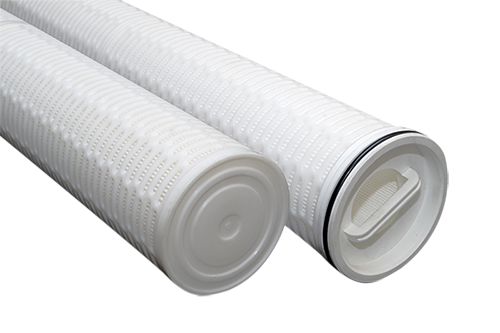
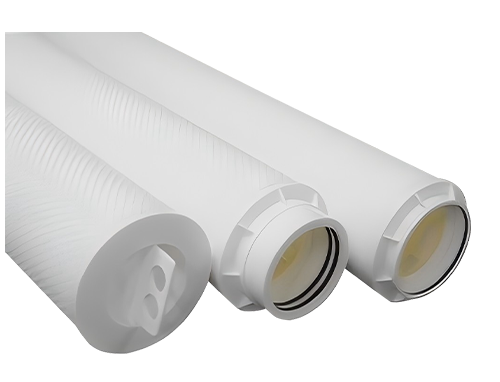
A high flow filter cartridge is a large-diameter filtration element—typically 6 inches (152 mm)—designed to handle extremely high flow rates while maintaining stable filtration efficiency and low pressure drop.
Compared with traditional 2.5-inch or 4.5-inch cartridges, high flow cartridges offer:
Much higher flow per cartridge
Fewer cartridges per housing
Reduced housing size
Lower installation and maintenance costs
Typical high flow filter cartridges are available in lengths of 20”, 40”, and 60”, with flow capacities that can reach 70–110 m³/h per cartridge, depending on the micron rating and media design.
Why Flow Rate Matters in High Flow Filter Cartridge Selection
Understanding Flow Rate
Flow rate refers to the volume of liquid that passes through a filter cartridge within a given time, usually expressed as:
m³/h (cubic meters per hour)
GPM (gallons per minute)
In high flow filtration systems, flow rate is critical because these systems are often used in:
RO pretreatment
Desalination plants
Power plant cooling water
Industrial process water
Large-scale municipal water treatment
High Flow vs. Traditional Cartridge Systems
| Filter Type | Typical Flow per Cartridge |
|---|---|
| 2.5” Standard Cartridge | 1–5 m³/h |
| 4.5” Big Blue Cartridge | 5–10 m³/h |
| High Flow Cartridge (6”) | 70–110 m³/h |
High flow filter cartridges drastically reduce the number of cartridges required, simplifying system design and reducing downtime during replacement.

Key Factors Affecting Flow Rate Performance
1. Cartridge Diameter and Length
The larger diameter of high flow cartridges provides a significantly larger filtration area. Longer cartridges (40” and 60”) naturally allow higher flow capacity than 20” cartridges.
2. Filtration Media Structure
Different media structures directly influence flow performance:
Pleated polypropylene (PP)
Glass fiber (GF)
Gradient density media
Optimized pleat geometry ensures uniform flow distribution and reduces localized pressure drop.
3. Contaminant Load
Higher suspended solids concentration leads to faster clogging, which reduces effective flow over time. This is why selecting the correct micron rating is just as important as flow capacity.
What Is Micron Rating in High Flow Filter Cartridges?
Micron Rating Explained
Micron rating defines the size of particles that a filter cartridge can remove.
One micron (µm) equals one-millionth of a meter.
Common micron ratings for high flow filter cartridges include:
1 µm
3 µm
5 µm
10 µm
20 µm
40 µm
70 µm
100 µm
Nominal vs. Absolute Micron Rating
Understanding the difference is essential:
Nominal rating: Removes a certain percentage (usually 60–90%) of particles at the stated size
Absolute rating: Removes ≥99.9% of particles at the stated size
For critical processes such as RO pretreatment or electronics water, absolute-rated high flow cartridges are strongly recommended.
How Micron Rating Affects Filtration Performance
Lower Micron Rating (1–5 µm)
Higher filtration accuracy
Better protection for downstream equipment
Higher initial pressure drop
Faster clogging if upstream contamination is high
Medium Micron Rating (10–20 µm)
Balanced filtration and flow
Common choice for industrial water treatment
Longer service life compared with finer filters
Higher Micron Rating (40–100 µm)
Very high flow capacity
Minimal pressure drop
Used for coarse filtration and pre-stage protection
Relationship Between Flow Rate and Micron Rating
Flow rate and micron rating are closely linked. In general:
Lower micron rating → lower flow rate → higher pressure drop
Higher micron rating → higher flow rate → lower pressure drop
Example Comparison
| Micron Rating | Typical Flow Capacity | Pressure Drop |
|---|---|---|
| 1 µm | Lower | Higher |
| 5 µm | Medium | Medium |
| 10 µm | High | Lower |
| 40 µm | Very High | Very Low |
This relationship explains why a single filtration system may use multiple stages of high flow cartridges with different micron ratings.
Common Applications and Recommended Flow & Micron Ratings
RO Pretreatment Systems
Typical micron rating: 5–10 µm
Purpose: Protect RO membranes from fouling
Balanced flow and accuracy
Seawater Desalination
Typical micron rating: 10–20 µm
High suspended solids tolerance
Long service life required
Power Plant Cooling Water
Typical micron rating: 20–40 µm
High flow demand
Stable operation over long periods
Food & Beverage Processing
Typical micron rating: 1–5 µm
High cleanliness requirements
Often absolute-rated filters
Why Correct Selection Reduces Total Filtration Cost
Choosing the right flow and micron rating combination:
Reduces cartridge replacement frequency
Minimizes pressure drop-related energy consumption
Protects downstream equipment
Improves system reliability
Many filtration failures are not caused by poor filter quality, but by incorrect selection.
Econe Filtration works closely with customers to analyze operating conditions and recommend the most cost-effective high flow filter cartridge configuration.
When to Use Multi-Stage High Flow Filtration
For systems with heavy contamination, a single micron rating may not be sufficient. Multi-stage filtration is often recommended:
First stage: 40–70 µm (coarse filtration)
Second stage: 10–20 µm (fine filtration)
Final stage: 1–5 µm (critical protection)
This approach extends cartridge life and improves overall system efficiency.
Related Articles for Further Reading
To help you better understand high flow cartridge filter selection and flow rate optimization, here are some related articles you may find useful:
Recommended Filter Cartridges

 English
 Spanish