
Correlation Between Membrane Micron Rating and Particle Retention Performance
Authors:
Danny Lu1
Affiliations:
1Econe Filtration, Zhejiang, Province of China
Abstract
Membrane filtration is widely used in water treatment, biopharmaceutical manufacturing, and industrial processes, where particle retention is critical for product quality and safety. The micron rating of a membrane is a primary indicator of its filtration capability, yet the actual particle retention performance may vary significantly depending on membrane material, pore distribution, and operational conditions. This study investigates the correlation between membrane micron rating and particle retention efficiency across different membrane types, including polypropylene (PP), polyethersulfone (PES), and polyvinylidene fluoride (PVDF). Standardized particle challenge tests were conducted using polystyrene latex (PSL) beads ranging from 0.1 μm to 10 μm under controlled pressure and flow conditions. The results demonstrate a strong inverse correlation between membrane micron rating and particle retention efficiency, with material-dependent variations. These findings provide a practical reference for selecting membranes for specific filtration applications and optimizing filtration performance.
Keywords
Membrane Filtration; Micron Rating; Particle Retention; PP Membrane; PES Membrane; PVDF Membrane; Filtration Efficiency
1. Introduction
Membrane filtration technology is a cornerstone in modern water treatment, food and beverage processing, and pharmaceutical manufacturing. The ability of a membrane to remove particles is often described by its micron rating, which indicates the nominal or absolute size of particles the membrane is expected to retain. Despite being a key specification, micron rating alone does not always predict actual filtration performance. Factors such as membrane material, surface properties, pore size distribution, and operational parameters can significantly affect particle retention.
Prior studies have highlighted the influence of material and pore structure on membrane performance. For instance, PES membranes often exhibit tighter pore distributions compared to PP membranes, leading to higher retention efficiencies at equivalent nominal micron ratings. PVDF membranes, known for their hydrophilicity and chemical resistance, are widely used in sterile filtration where submicron particle removal is essential.
Understanding the quantitative correlation between micron rating and particle retention efficiency is crucial for designing filtration systems that meet regulatory standards and operational requirements. This study aims to systematically evaluate this correlation across three common membrane materials, providing experimental data and practical guidance for membrane selection.
2. Materials and Methods
2.1 Membrane Samples
The study tested membranes from three materials with varying nominal micron ratings:
| Material | Micron Ratings Tested | Configuration |
|---|---|---|
| PP (Polypropylene) | 0.5 μm, 1 μm, 5 μm | Pleated |
| PES (Polyethersulfone) | 0.2 μm, 0.45 μm, 1 μm | Flat sheet & pleated |
| PVDF (Polyvinylidene Fluoride) | 0.1 μm, 0.22 μm, 0.45 μm | Pleated |
All membranes were supplied by [Supplier Name] and conditioned according to manufacturer recommendations before testing.
2.2 Particle Challenge Tests
Particle retention was assessed using standardized polystyrene latex (PSL) beads. The test protocol included:
Particle sizes: 0.1 μm, 0.2 μm, 0.5 μm, 1 μm, 5 μm, and 10 μm.
Filtration conducted under constant pressure (2 bar) and flow rate (1 L/min).
Upstream and downstream particle concentrations measured using a laser particle counter (Model XYZ).
Each test repeated in triplicate for statistical accuracy.
Particle Retention Efficiency (PRE) was calculated as:
PRE (%) = (1 – (Cdownstream / Cupstream)) × 100
where Cupstream and Cdownstream are particle concentrations before and after filtration.
2.3 Data Analysis
Regression analysis was performed to determine the correlation between micron rating and particle retention efficiency.
Material influence was analyzed by comparing retention efficiencies at the same nominal micron rating across PP, PES, and PVDF membranes.
Statistical significance was evaluated using one-way ANOVA (p < 0.05).
3. Results
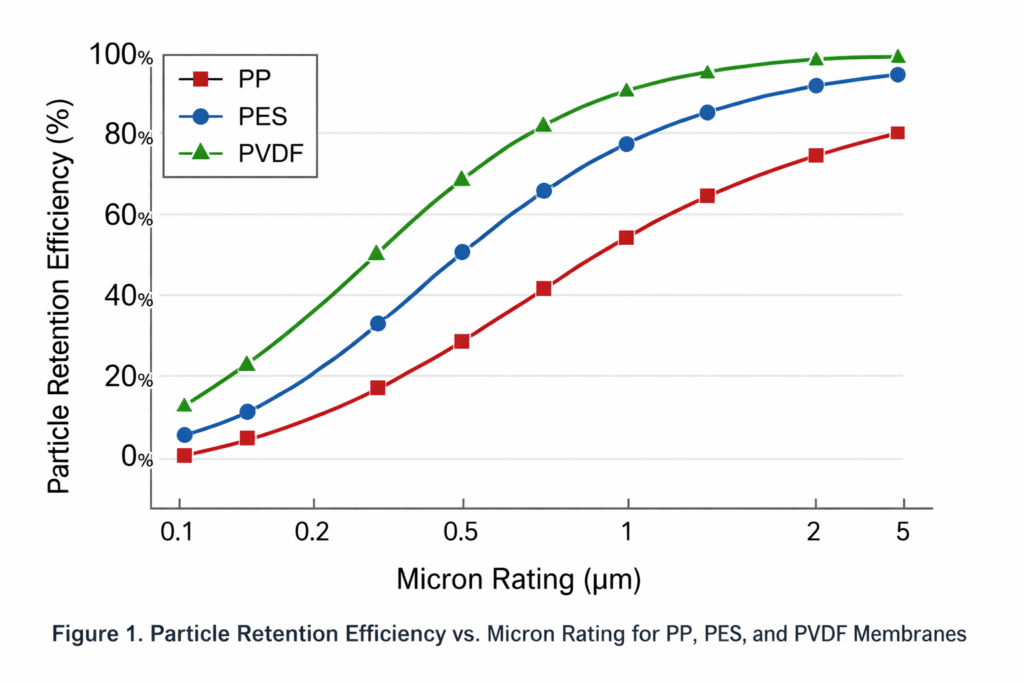
3.1 Particle Retention Efficiency vs. Micron Rating
The results confirm that particle retention efficiency improves as micron rating decreases. Table 1 summarizes the average PRE for each membrane type:
Table 1. Particle Retention Efficiency (%) Across Membranes
| Material | Micron Rating | 0.1 μm | 0.2 μm | 0.5 μm | 1 μm | 5 μm | 10 μm |
|---|---|---|---|---|---|---|---|
| PP | 5 μm | 12 | 18 | 35 | 65 | 90 | 98 |
| PP | 1 μm | 25 | 40 | 70 | 85 | 96 | 99 |
| PP | 0.5 μm | 40 | 60 | 85 | 92 | 98 | 99.5 |
| PES | 1 μm | 45 | 65 | 90 | 95 | 99 | 99.8 |
| PES | 0.45 μm | 60 | 80 | 95 | 98 | 99.5 | 99.9 |
| PES | 0.2 μm | 75 | 90 | 98 | 99 | 99.8 | 100 |
| PVDF | 0.45 μm | 70 | 85 | 95 | 98 | 99.5 | 99.9 |
| PVDF | 0.22 μm | 85 | 95 | 99 | 99.5 | 99.8 | 100 |
| PVDF | 0.1 μm | 92 | 98 | 99.5 | 99.8 | 100 | 100 |
3.2 Material Influence
PES membranes outperform PP membranes at the same nominal micron rating due to more uniform pore distribution.
PVDF membranes excel in submicron particle retention, confirming suitability for sterile and pharmaceutical applications.
The variance between nominal and absolute retention is smaller in PVDF and PES compared to PP.
3.3 Graphical Representation
Figure 1. Particle Retention Efficiency vs. Micron Rating for PP, PES, and PVDF Membranes
4. Discussion
4.1 Correlation Between Micron Rating and Retention Efficiency
The experimental results demonstrate a strong inverse correlation between micron rating and particle retention efficiency. Membranes with lower nominal micron ratings consistently captured a higher percentage of particles across all tested sizes.
PP membranes showed linear improvement as the micron rating decreased from 5 μm to 0.5 μm, particularly for particles above 1 μm.
PES and PVDF membranes provided higher absolute retention efficiency for submicron particles, reflecting their tighter pore distribution and material characteristics.
The deviation between nominal and absolute retention was most significant for PP membranes, highlighting that micron rating alone is insufficient to predict retention performance without considering material and pore uniformity.
4.2 Material-Dependent Performance
Membrane material significantly influences particle retention efficiency:
PP (Polypropylene): Lightweight, cost-effective, but larger variance between nominal and absolute retention due to broader pore distribution. Best suited for pre-filtration and applications where submicron removal is not critical.
PES (Polyethersulfone): Higher retention for submicron particles due to tighter pore uniformity. Hydrophilic nature enhances wetting and reduces particle bypass. Ideal for water treatment and food & beverage applications.
PVDF (Polyvinylidene Fluoride): Excellent chemical resistance and submicron particle retention. Optimal for sterile filtration, pharmaceuticals, and microelectronics.
The material-dependent differences suggest that filtration system design must consider both micron rating and membrane material to achieve the desired retention efficiency.
4.3 Practical Implications for Filtration System Design
Selecting membranes based solely on nominal micron rating may lead to underperformance.
Submicron applications, such as sterile filtration, require verification of absolute retention efficiency, preferably through particle challenge tests or bubble point tests.
Flow rate, pressure, and chemical compatibility are additional factors that affect performance; membrane choice must balance these operational constraints with particle retention requirements.
Figure 2. Recommended Membrane Selection Matrix
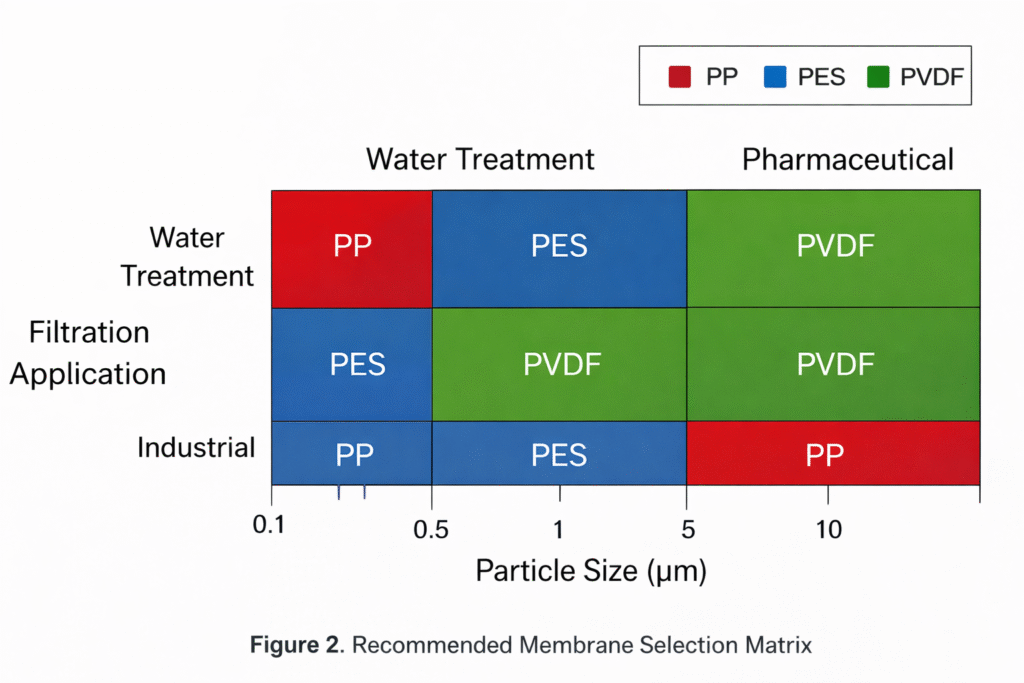
X-axis: Particle Size (μm)
Y-axis: Filtration Application (Water Treatment, Pharmaceutical, Industrial)
Color-coded: Suitable Membrane Material (PP, PES, PVDF)
5. Conclusion
This study confirms that membrane micron rating correlates inversely with particle retention efficiency, while material properties strongly modulate absolute performance. Key findings include:
Lower micron ratings yield higher particle retention efficiency across all tested membranes.
PES and PVDF membranes outperform PP membranes at equivalent nominal micron ratings, especially for submicron particles.
Practical membrane selection must consider both micron rating and material characteristics to ensure performance reliability.
These findings provide a quantitative reference for engineers and scientists in water treatment, pharmaceutical, and industrial filtration, aiding in optimal membrane selection and process design.
6. Data Availability
All experimental data supporting this study are available from the corresponding author upon reasonable request.
7. Funding
This research received no external funding.
8. Conflict of Interest
The authors declare no conflict of interest.
9. References
Baker, R.W. Membrane Technology and Applications, 4th Edition, John Wiley & Sons, 2012.
Mulder, M. Basic Principles of Membrane Technology, 2nd Edition, Springer, 2000.
Li, X., et al. “Particle Retention of Polyethersulfone Membranes in Water Treatment.” Journal of Membrane Science, 2019, 587, 117189.
Lu, Danny (Editor). “Membrane Micron Rating and Particle Retention.” Desalination, 2026, 1–9.
 English
 Spanish