
How to Choose the Right Cartridge Filter Flow Rate for Your Filtration System
INTRODUCTION
Selecting the correct cartridge filter flow rate is one of the most important decisions in designing or upgrading a filtration system. Whether you are working in water treatment, food and beverage processing, microelectronics, biopharmaceuticals, or industrial manufacturing, the flow rate directly affects system efficiency, product quality, energy consumption, and long-term operating costs.
This guide provides a comprehensive explanation of cartridge filter flow rate, why it matters, how to calculate it, and practical steps to choose the right specifications for your filtration needs.
1. What Is Cartridge Filter Flow Rate?
The cartridge filter flow rate refers to the volume of fluid that can pass through a filter cartridge per unit of time, typically measured in liters per minute (LPM), gallons per minute (GPM), or cubic meters per hour (m³/h).
Flow rate is not a static number—it depends on several variables, including:
Filter Media Type – Polypropylene (PP), PTFE, PVDF, PES, Nylon, etc. Each material has different permeability and resistance.
Micron Rating – Smaller pore size increases filtration efficiency but restricts flow.
Cartridge Dimensions – Length, diameter, and pleat design determine effective filtration area.
Fluid Properties – Viscosity, density, temperature, and presence of suspended solids all impact flow.
System Pressure – Higher inlet pressure can drive more fluid through the filter.
Differential Pressure (ΔP) – The pressure drop across the cartridge determines how much flow is sustainable before clogging occurs.
In short, the cartridge filter flow rate is a balance between filtration performance and hydraulic efficiency.
Learn More >> How to Choose the Filter Cartridge Membrane Material for Your Filtration Systems
2. Why Flow Rate Selection Matters
Choosing the correct flow rate is not just about meeting throughput requirements. It also affects:
(a) Filtration Efficiency
If the flow rate is too high, contaminants may bypass or break through the filter media, reducing filtration quality. For example, in pharmaceutical applications, this could lead to product contamination or regulatory compliance failures.
(b) Filter Service Life
Running a filter cartridge at an excessively high flow rate increases differential pressure and accelerates clogging. This reduces cartridge lifespan and increases replacement costs.
(c) Energy Consumption
Pumps must work harder to maintain flow through clogged or undersized filters. An optimal flow rate minimizes unnecessary energy costs.
(d) Product Consistency
In beverage and food processing, flow rates that fluctuate too much can cause inconsistent product taste, clarity, and safety.
(e) System Safety
High differential pressures caused by excessive flow can damage filter cartridges, housings, or seals, potentially leading to system downtime.
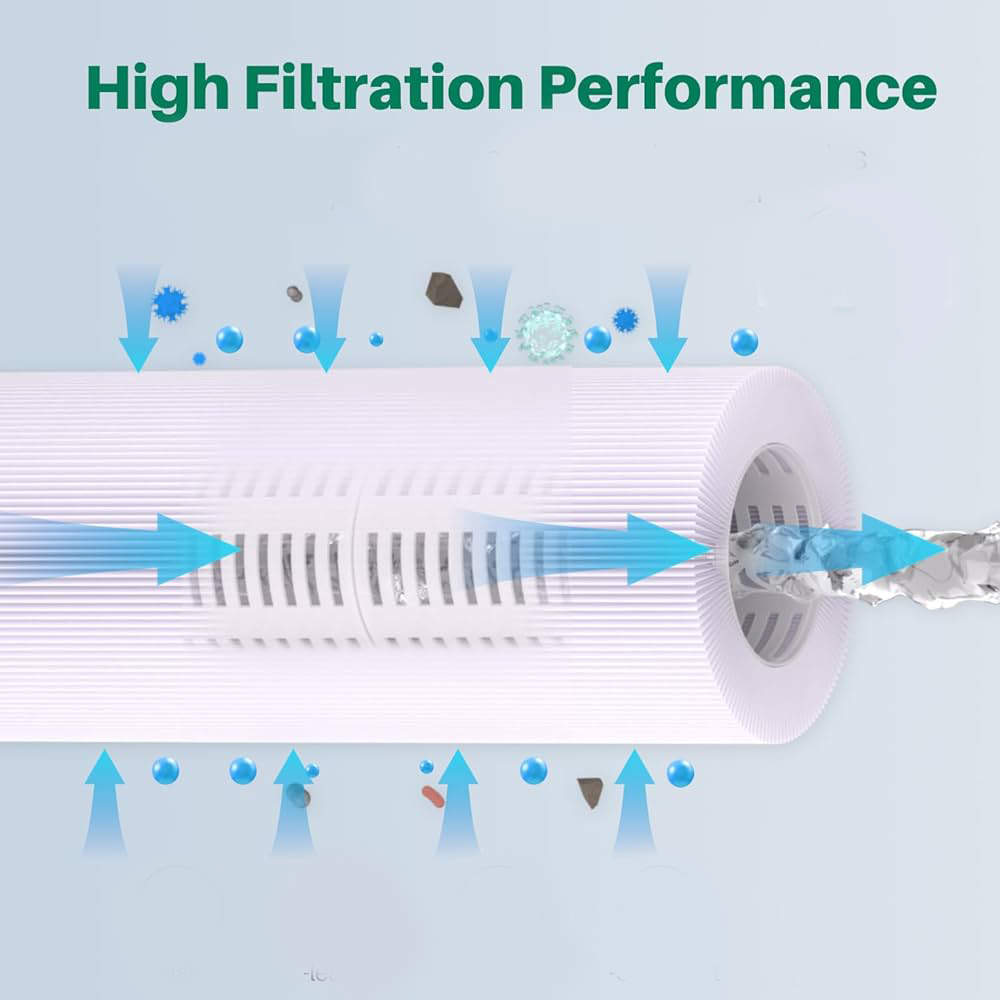
3. Key Factors That Determine Filter Cartridge Flow Rate
Selecting the right filter cartridge flow rate involves understanding both filter design and system requirements. The following are the most important factors:
3.1 Micron Rating
The micron rating indicates the particle retention size of the cartridge. For example:
0.2–0.45 micron – Sterile filtration in biopharmaceuticals.
1–5 micron – Beverage and bottled water clarity.
10–50 micron – Industrial water and general liquid pre-filtration.
Smaller micron ratings increase filtration precision but reduce flow capacity.
Learn More >> How to Choose the Right Filter Micron Rating for Cartridges
3.2 Cartridge Dimensions
Length – Standard lengths include 10, 20, 30, and 40 inches. Longer cartridges offer greater surface area, enabling higher flow rates.
Diameter – Larger diameters provide more filtration area. For example, high flow cartridges (6–8 inches diameter) can replace multiple standard 2.5-inch cartridges.
3.3 Cartridge Design
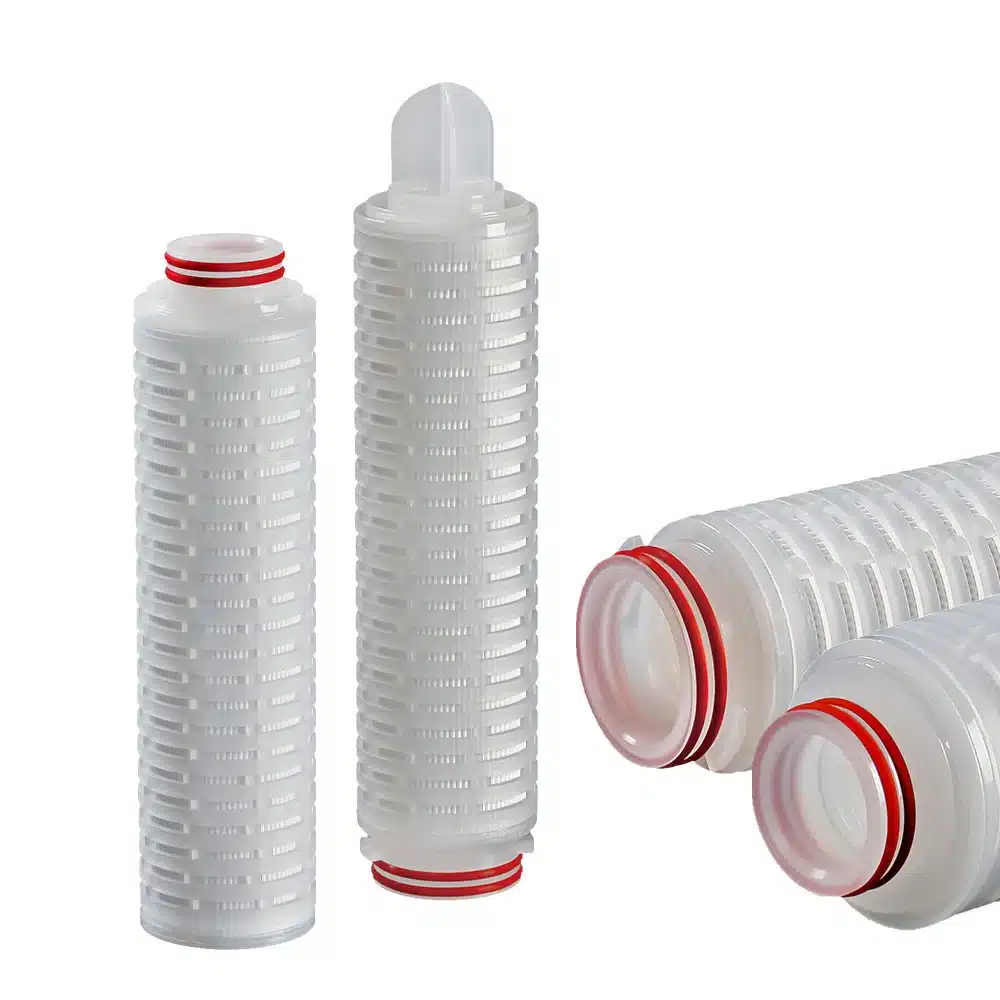
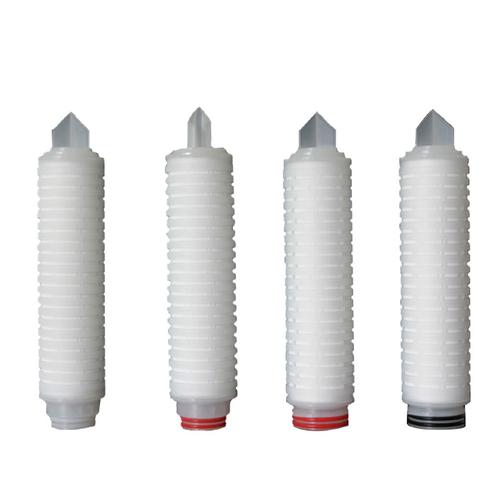
Pleated Filter cartridges – Maximize surface area, support higher flow, and longer service life.
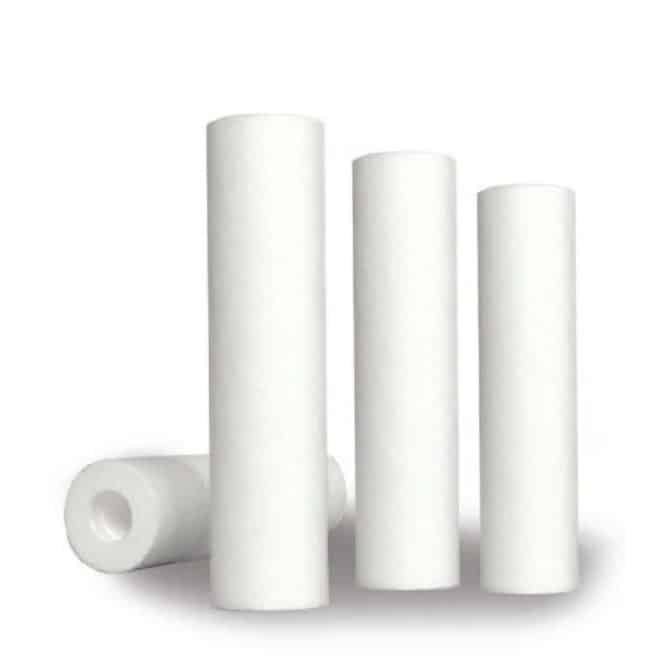
Depth Filters – Capture particles throughout the thickness, suitable for lower flow and high dirt-holding capacity.
High Flow Filter Cartridges – Specifically designed for large-scale operations, handling higher throughput with fewer cartridges.
Learn More >> Advantages of Pleated Filter Cartridges Compared to Depth Filter Cartridges
Types of Filter Cartridge Comparison

3.4 Fluid Characteristics
Viscosity – Thicker fluids (like oils, syrups, or chemicals) flow more slowly than water-like liquids.
Temperature – Higher temperatures can reduce fluid viscosity, slightly increasing flow.
Solid Content – High turbidity fluids clog filters faster, reducing sustainable flow rates.
3.5 Operating Pressure
The available pump pressure and acceptable pressure drop (ΔP) across the filter must be considered. Typically, most cartridge filters are designed for an initial ΔP of 0.07–0.14 MPa (10–20 psi).
If you are looking for reliable filter cartridges with stable flow performance, explore our Pleated Filter Cartridge — designed for high filtration efficiency and excellent chemical compatibility.
Request a Quote
4. Industry Guidelines for Flow Rates
While each manufacturer provides detailed flow performance charts, general guidelines exist for typical cartridge filter applications:
Standard 10-inch pleated cartridge – 5 to 10 GPM (18–38 LPM) for water-like fluids.
20-inch pleated cartridge – 10 to 20 GPM (38–76 LPM).
30-inch pleated cartridge – 15 to 30 GPM (57–114 LPM).
40-inch pleated cartridge – 20 to 40 GPM (76–151 LPM).
For high flow cartridges, the capacity can reach 80–300 GPM per cartridge, depending on size and application.
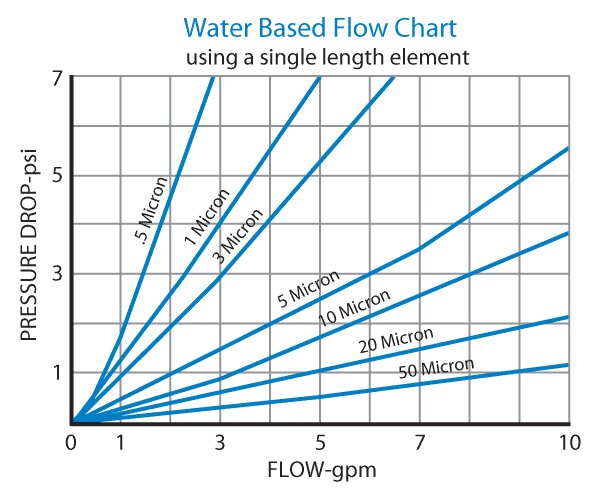
5. How to Calculate Required Flow Rate
Determining the required filter cartridge flow rate involves several steps:
Step 1: Identify System Flow Demand
Calculate the total volume of fluid that needs filtration per unit of time. For example:
A bottling line requires 15,000 liters per hour (L/h) of filtered water.
Convert to LPM: 15,000 ÷ 60 = 250 LPM.
Step 2: Consider Filter Cartridge Capacity
If each 10-inch pleated filter cartridge provides 25 LPM, the system would require:
250 ÷ 25 = 10 cartridges.
Step 3: Adjust for Safety Factor
It is advisable to add a 20–30% safety margin to allow for pressure drop, filter aging, and operating variations.
10 cartridges × 1.2 = 12 cartridges recommended.
Step 4: Factor in Fluid Characteristics
If the fluid is more viscous or contains higher solid content, derating the flow by 30–50% may be necessary.
6. Filter Cartridge Flow Rate in Different Industries
6.1 Water Treatment
Municipal and industrial water treatment requires high volumes at relatively low micron ratings (1–10 µm). High flow cartridges are preferred to reduce housing footprint and replacement frequency.
6.2 Food & Beverage
Beverage manufacturers (beer, wine, bottled water, dairy) require stable and consistent flow to maintain clarity and safety. Overdriving cartridges risks compromising taste and quality.
6.3 Biopharmaceuticals
Sterile filtration demands precision. Flow rates must be carefully matched to avoid damaging sensitive biological products or compromising sterility. Typically, flow per 10-inch cartridge ranges 3–7 LPM for 0.2–0.45 µm filters.
6.4 Microelectronics
Ultrapure water (UPW) systems use fine micron filters at controlled flow rates to avoid particle shedding or ionic contamination. Flow capacity is lower per cartridge due to extremely tight pore structures.
6.5 Petrochemical and Industrial
High-viscosity fluids require oversized filtration setups. Flow per cartridge can be significantly reduced compared to water-based processes.
7. Common Mistakes When Choosing Flow Rate
Oversizing Flow per Cartridge – Leads to premature clogging and reduced filter life.
Ignoring Fluid Viscosity – Assuming water-like performance for oils or chemicals results in underperforming systems.
Skipping Safety Factor – Without extra margin, system downtime becomes frequent.
Mismatching Micron Rating and Flow – Choosing smaller micron size without accounting for reduced flow capacity.
Not Considering Scalability – Systems that later increase production demand can overwhelm undersized filter setups.
8. Practical Tips for Selecting Cartridge Flow Rate
Always consult manufacturer flow curves for specific cartridge models.
For viscous fluids, use pilot testing to validate flow assumptions.
Use larger diameter or high flow cartridges to reduce housing size and operating costs.
Monitor differential pressure regularly; replace filters when ΔP reaches 2–3 bar (30–45 psi).
Balance flow distribution across all cartridges in multi-cartridge housings.
9. Advanced Strategies for Optimizing Cartridge Filter Flow Rate
9.1 Use of High Flow Cartridge Filters
High flow cartridge filters are designed to handle very large volumes with fewer cartridges. Instead of installing multiple standard 2.5-inch cartridges, a single 6-inch diameter high flow cartridge can process hundreds of gallons per minute.
Benefits include:
Reduced housing size and footprint.
Lower labor cost during change-outs.
Longer service intervals.
Lower total cost of ownership.
These cartridges are particularly effective in power plants, petrochemical industries, and large-scale water treatment.
9.2 Staged Filtration Design
Instead of using a single fine filter cartridge to capture all particles, staged filtration allows for pre-filtration followed by final polishing. For example:
Stage 1: 20 µm depth filter (handles high solid load, extends life of final filter).
Stage 2: 5 µm pleated filter.
Stage 3: 0.45 µm sterilizing filter.
This design improves flow capacity, reduces clogging, and lowers replacement costs.
9.3 Parallel and Series Configuration
Parallel Configuration – Splitting flow across multiple housings reduces flow per cartridge, increasing efficiency and cartridge life.
Series Configuration – Installing filters in series with decreasing micron ratings ensures optimal protection for sensitive downstream equipment.
9.4 Monitoring and Automation
Advanced filtration systems integrate pressure gauges, flow sensors, and automated alerts. Monitoring differential pressure in real-time helps operators maintain stable flow rates and replace cartridges before critical failure.
9.5 Matching Pump Performance with Filter Flow Rate
Your pump must be sized correctly to maintain required flow without generating excessive pressure. Pumps that exceed cartridge limits can lead to filter collapse, while undersized pumps may fail to deliver production demand.
10. Real-World Examples of Cartridge Flow Rate Selection
Example 1: Bottled Water Plant
Requirement: 50,000 liters/hour of filtered water.
Filter Chosen: 30-inch pleated PP cartridge, rated 30 GPM (114 LPM).
Calculation:
50,000 ÷ 60 = 833 LPM.
833 ÷ 114 = 7.3 ≈ 8 cartridges.
Adjustment: With a 25% safety margin → 10 cartridges required.
Example 2: Biopharmaceutical Production
Requirement: Sterile filtration of injectable solutions, 0.22 µm.
Filter Chosen: 10-inch PES pleated cartridge, rated 5 LPM.
Calculation:
600 liters/hour = 10 LPM.
10 ÷ 5 = 2 cartridges.
Adjustment: With critical sterility requirement, double redundancy is recommended. → 4 cartridges installed.
Example 3: Petrochemical Plant
Requirement: Filter 200 m³/h of viscous fluid (twice as viscous as water).
Filter Chosen: 40-inch high flow cartridge, rated 250 LPM for water.
Calculation (with viscosity correction):
Effective flow per cartridge = 125 LPM.
200,000 ÷ 60 = 3333 LPM.
3333 ÷ 125 = 26.6 ≈ 27 cartridges.
By choosing high flow housings, the plant reduces the number of cartridges compared to hundreds of standard filters.
11. FAQs About Cartridge Filter Flow Rate
Q1: What happens if I exceed the recommended cartridge flow rate?
Exceeding flow limits increases differential pressure, shortens cartridge life, and risks particle breakthrough. It may also damage the filter media.
Q2: Can I use fewer cartridges to save cost if my pump has higher pressure?
Not recommended. High pressure does not compensate for insufficient filtration area. It may push contaminants through the filter and damage the cartridge.
Q3: How do I know when to replace a cartridge?
Monitor differential pressure. Replace cartridges when ΔP reaches 2–3 bar (30–45 psi), or earlier if product quality declines.
Q4: What’s the difference between clean water flow rate and actual process flow rate?
Clean water flow rate is tested with water under controlled conditions. Actual process flow may be lower due to viscosity, solids, and operating conditions. Always derate for real-world applications.
Q5: Should I choose pleated or depth cartridges for high flow applications?
Pleated cartridges are better for higher flow because they maximize surface area. Depth cartridges are more suitable for high dirt-holding capacity but lower flow.
12. Best Practices for Engineers and Procurement Managers
Always start with total system demand before sizing individual cartridges.
Consider housing space, installation cost, and labor cost alongside cartridge price.
Choose high flow cartridges when scaling up production.
In regulated industries, always confirm with validation data and manufacturer’s certification.
Regularly train operators on flow monitoring and cartridge replacement schedules.
13. Conclusion
Selecting the correct cartridge filter flow rate is not just a technical detail—it is a strategic decision that impacts production efficiency, product safety, regulatory compliance, and long-term costs.
By considering factors such as micron rating, cartridge design, fluid characteristics, and system demand, you can avoid common pitfalls and build a filtration system that performs reliably.
Whether you operate a biopharmaceutical cleanroom, a beverage bottling line, a microelectronics water plant, or an industrial chemical process, following the principles outlined in this guide ensures that your filtration system runs at peak efficiency.
When in doubt, consult with cartridge manufacturers, request flow performance charts, and perform small-scale pilot tests before full-scale implementation. Investing time upfront in selecting the right cartridge filter flow rate will yield significant long-term benefits.
Related Articles for Further Reading
To help you better understand cartridge filter selection and flow rate optimization, here are some related articles you may find useful:
Recommended Filter Cartridges
 English
 Spanish