
Nominal vs Absolute Micron Rating: What’s the Real Difference?

Understanding Micron Rating in Industrial Filtration Systems
In industrial and process filtration, micron rating is one of the most frequently cited — and most frequently misunderstood — specifications. Buyers often compare filter cartridges based on a single micron value, assuming that two filters with the same micron rating will deliver the same level of performance. In reality, micron rating alone does not fully describe a filter’s true separation capability, reliability, or suitability for a specific application.
Common Misconceptions About Micron Ratings
Some of the most common misunderstandings include:
“A 5 µm filter always removes all particles larger than 5 µm.”
“Two filters with the same micron rating perform the same.”
“Nominal and absolute micron ratings are interchangeable.”
These assumptions are incorrect and often lead to poor filter selection. Understanding the difference between nominal and absolute micron rating is essential for making informed decisions in industrial filtration systems.
2. What Is Nominal Micron Rating?
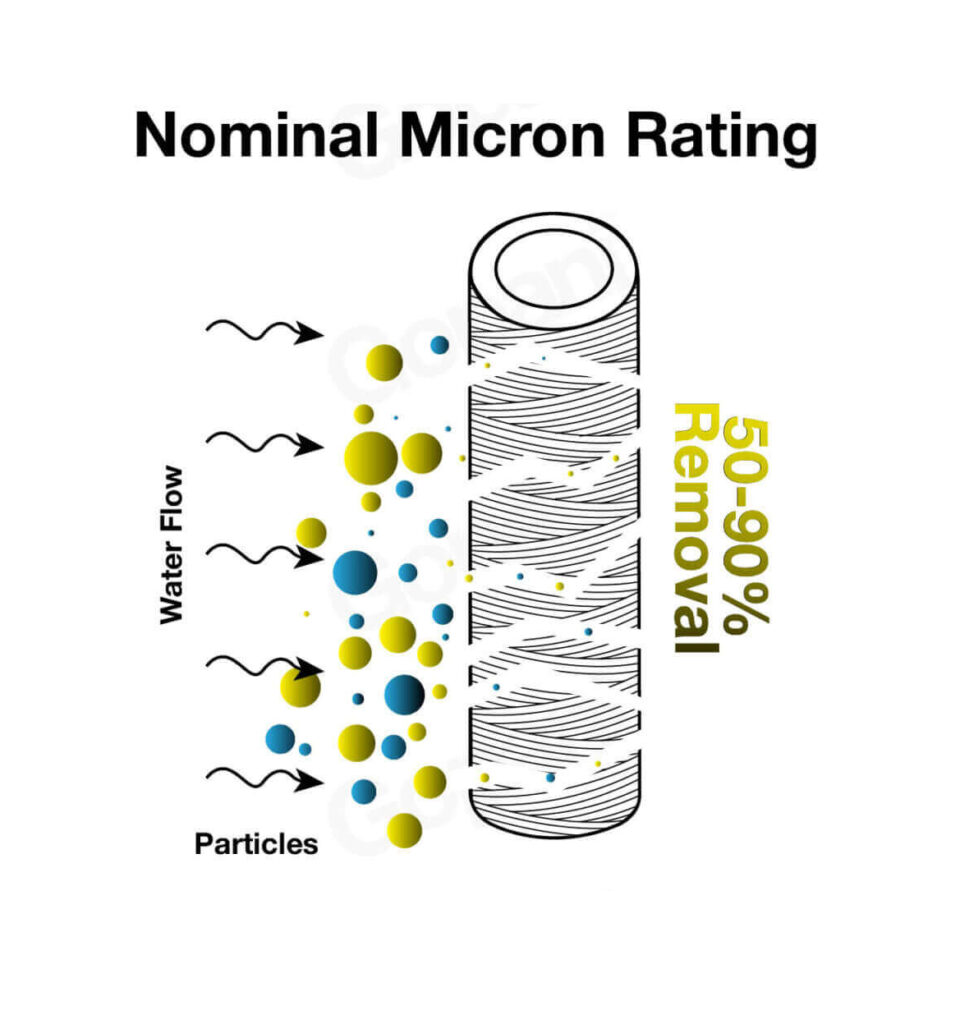
A nominal micron rating refers to a filter’s ability to reduce a certain percentage of particles at or above a stated size. Unlike absolute ratings, nominal ratings are probabilistic, not definitive.
Technical Definition
Nominal micron rating is typically defined as the particle size at which a filter achieves a specified, but limited, retention efficiency, commonly ranging between 60% and 90%, depending on the manufacturer and test method.
For example, a filter labeled as “10 µm nominal” may remove:
60% of particles ≥10 µm (one manufacturer)
80% of particles ≥10 µm (another manufacturer)
90% of particles ≥10 µm (yet another interpretation)
There is no single global standard that mandates what percentage qualifies as “nominal,” which means nominal micron ratings can vary significantly between suppliers.
>>Learn More: What is Nominal micron rating
How Nominal Ratings Are Determined
Nominal ratings are usually derived from:
Multi-pass filtration tests
Particle count upstream and downstream
Statistical efficiency curves
Because the pore structure of many nominal-rated filters is non-uniform, particles smaller than the nominal rating may be retained, while some larger particles may still pass through.
Advantages of Nominal Micron Rated Filters
Nominal-rated filters are widely used because they offer several practical advantages:
Lower cost compared to absolute-rated filters
Higher dirt-holding capacity due to depth-type media
Lower initial pressure drop in many applications
Suitable for fluids with high contaminant loads
These characteristics make nominal filters an economical choice for non-critical filtration stages.
Limitations of Nominal Micron Ratings
Despite their advantages, nominal-rated filters have important limitations:
Inconsistent particle retention
Greater variability between production batches
Higher risk of downstream particle passage
Limited suitability for critical or regulated processes
Because of these limitations, nominal ratings should not be used where precise particle control or regulatory compliance is required.
Typical Applications of Nominal Micron Rated Filters
Nominal micron rated filters are commonly used in:
Pre-filtration before membrane systems
Industrial water treatment clarification
Cooling water and utility systems
General-purpose industrial fluid filtration
Applications where cost efficiency outweighs absolute retention needs
In these scenarios, nominal filtration provides adequate protection without unnecessary expense.
3. What Is Absolute Micron Rating?
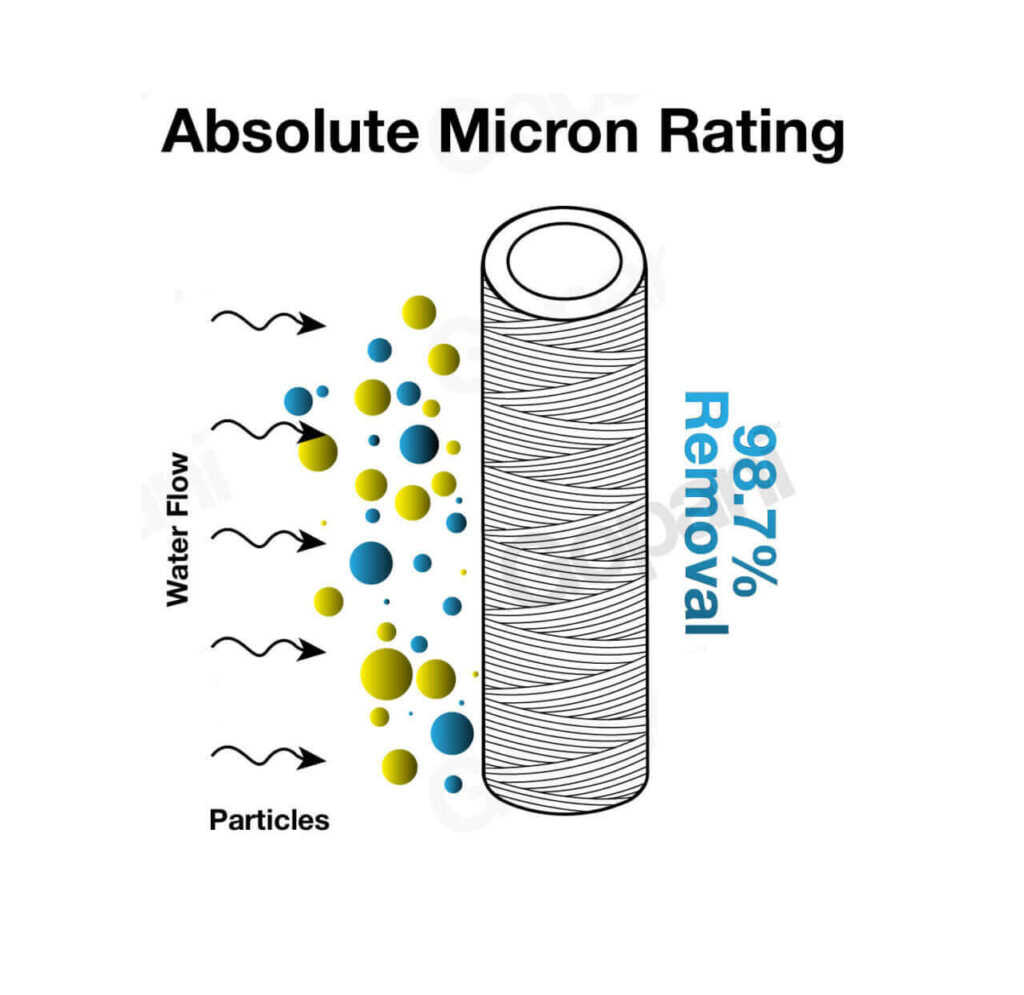
An absolute micron rating represents the particle size at which a filter achieves near-total particle retention, typically ≥99.9% efficiency. Unlike nominal ratings, absolute ratings are intended to provide a clearly defined and verifiable performance limit.
Technical Definition
A filter with an absolute micron rating is designed to prevent the passage of particles larger than its rated pore size under defined test conditions. While no physical filter can guarantee 100% retention in every scenario, absolute-rated filters aim to approach complete retention with minimal variability.
For example, a 5 µm absolute filter is expected to retain at least 99.9% of particles ≥5 µm, often validated through standardized integrity or challenge testing.
Learn More>> What is Absolute Micron Rating
Key Characteristics of Absolute-Rated Filters
Absolute-rated filters typically feature:
Highly controlled pore size distribution
Uniform filtration structure
Consistent performance across production batches
Validation through integrity testing
These characteristics are especially important in applications where filtration failure could lead to safety, quality, or compliance risks.
Advantages of Absolute Micron Rated Filters
Absolute micron rated filters provide several critical benefits:
High and predictable filtration efficiency
Reliable protection of downstream processes
Suitability for regulated industries
Compatibility with validation and documentation requirements
Because of these advantages, absolute-rated filters are often required in industries with strict quality standards.
Cost and Operational Considerations
The enhanced performance of absolute-rated filters comes with trade-offs:
Higher manufacturing cost
Typically higher pressure drop
Lower dirt-holding capacity compared to depth filters
As a result, absolute filters are usually applied selectively at critical points in the filtration system rather than throughout the entire process.
Typical Applications of Absolute Micron Rated Filters
Absolute micron rated filters are widely used in:
Pharmaceutical and biotechnology processing
Food and beverage final filtration
Microelectronics and semiconductor manufacturing
High-purity water systems
Critical product protection stages
In these environments, consistent and verifiable particle retention is essential.
4. Nominal vs Absolute Micron Rating: Engineering Comparison
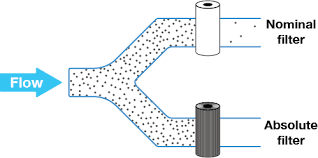
When selecting a filter cartridge, understanding the practical differences between nominal and absolute ratings is crucial. While both terms reference particle size, they differ significantly in performance predictability, reliability, and application suitability.
Key Comparison Factors
| Factor | Nominal Rating | Absolute Rating |
|---|---|---|
| Particle retention | Percentage-based (60–90%) | Near-total (≥99.9%) |
| Filtration consistency | Variable between batches | Highly consistent |
| Test validation | Basic particle challenge | Integrity tests (bubble point, pressure hold) |
| Downstream protection | Partial | Full protection for critical systems |
| Pressure drop behavior | Typically lower initially | Higher, stable over life |
| Cost | Lower | Higher |
| Typical media | Depth media (PP, cellulose, blended) | Membrane or pleated media with controlled pore size |
Performance Considerations
Consistency Over Life
Absolute-rated filters maintain their rated efficiency throughout the service life, while nominal filters may show gradual efficiency loss as larger channels clog unevenly.Downstream Equipment Protection
Nominal filters provide general protection but cannot guarantee critical particle exclusion. Absolute filters safeguard sensitive equipment such as ultrafiltration membranes, pumps, and precision instruments.Impact on Operating Costs
While nominal filters are cheaper upfront, absolute filters reduce risk-related costs by minimizing product loss, contamination, and system downtime.Application Strategy
Many systems benefit from a dual-stage approach: nominal-rated filters for pre-filtration, followed by absolute-rated filters for final protection.
5. How Micron Ratings Are Defined in Industry Standards
Micron rating terminology lacks a single, universally enforced standard, which can cause confusion for buyers. However, various industry practices and testing methods provide guidelines.
Nominal Rating Standards
Often defined as the particle size at which 60–90% of particles are retained
Testing may follow multi-pass filtration methods using specific challenge particles
Variability arises because each manufacturer chooses their particle type, concentration, and test flow rate
Not formally codified in ISO or ASTM, though some references exist in ISO 16889 (multi-pass testing)
Absolute Rating Standards
Defined to meet near-total particle retention, typically ≥99.9%
Requires rigorous integrity testing, including:
Bubble point test: Ensures pores are intact and meet the claimed size
Diffusion flow or pressure-hold tests: Confirms consistency across the membrane
Often referenced in pharmaceutical, food & beverage, and high-purity water systems
Absolute-rated filters may comply with ASTM F3160, ISO 21501, or USP <1231> depending on industry
Why Standards Matter
Filters with documented testing are easier to validate and audit
Avoids misinterpretation of micron ratings across suppliers
Ensures customers receive repeatable, predictable filtration performance
6. Test Methods Used for Nominal Micron Rating
Testing nominal-rated filters is less rigorous than absolute-rated filters but still provides valuable information about filter behavior.
Multi-Pass Testing
The filter is challenged with a known concentration of particles
Fluid passes multiple times through the filter
The percentage of retained particles is measured to determine the nominal rating
Particle Counting Methods
Laser particle counters or microscopy may be used
Creates retention efficiency curves showing particle capture at different sizes
Typically used for general industrial water, process fluids, and non-critical applications
Beta Ratio (βx)
β ratio is a common statistical tool in filtration science:
βx=Number of particles ≥ x upstreamNumber of particles ≥ x downstream\beta_x = \frac{\text{Number of particles ≥ x upstream}}{\text{Number of particles ≥ x downstream}}βx=Number of particles ≥ x downstreamNumber of particles ≥ x upstream
Nominal ratings are often associated with βx values between 2 and 10
Indicates partial filtration, suitable for pre-filtration
Limitations of Nominal Testing
Filter efficiency varies across production batches
Particle retention is probabilistic, not guaranteed
Smaller particles may pass through depending on flow rate and contamination load
7. Test Methods Used for Absolute Micron Rating
Absolute-rated filters undergo more stringent testing, which ensures predictable and reliable performance.
Bubble Point Test
Measures the largest pore opening by forcing gas through a wet filter
If the bubble point is as specified, the filter meets its claimed absolute rating
Widely used in liquid filtration for pharmaceuticals and high-purity fluids
Diffusion Flow Test
Quantifies the gas or liquid flow through a wetted membrane
Confirms uniform pore structure and absence of defects
Helps verify batch-to-batch consistency
Pressure-Hold Test
Applies a defined pressure and holds for a set period
Confirms the filter does not allow particle passage under operating conditions
Common in critical industrial processes and validated production environments
Why Absolute Testing Is Critical
Guarantees ≥99.9% retention of particles at or above the rated size
Supports regulatory compliance in food, pharmaceutical, and biotech applications
Provides confidence in final product quality and process safety

8. Why Micron Rating Numbers Alone Can Be Misleading
While micron ratings provide a useful benchmark, relying solely on the number can lead to incorrect filter selection. This is particularly true in industrial applications where process reliability and product protection are critical.
Key Factors Affecting Filtration Performance
Filter Media Type
Polypropylene (PP), Polyethersulfone (PES), PTFE, PVDF, and cellulose-based filters all have different pore structure uniformity, chemical compatibility, and flow characteristics.
A 5 µm filter in PP may not perform the same as a 5 µm PES pleated filter.
Filter Construction
Depth filters (nominal rating) have varying retention along the filter depth, which increases dirt-holding capacity but reduces absolute retention.
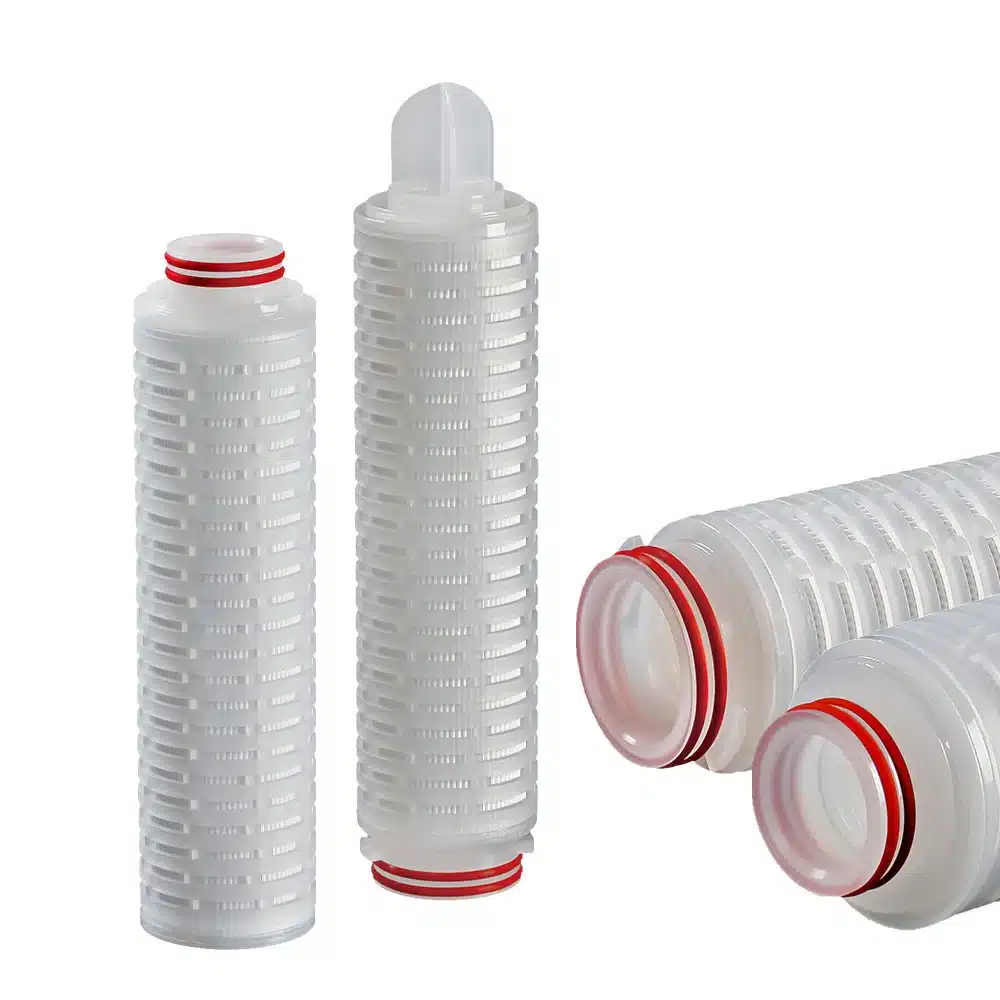
Pleated membrane filters (absolute rating) have uniform pore structure, providing predictable retention.
Flow Rate and Pressure
Higher flow rates can reduce retention efficiency, especially for nominal-rated filters.
Pressure drop also influences effective pore size and particle passage.
Particle Characteristics
Particle shape, density, and adhesion influence retention.
Irregular or fibrous particles may pass through nominal filters even if larger than the rated micron size.
Batch Variability
Manufacturing tolerances mean two nominal-rated filters from the same supplier can perform differently.
Absolute-rated filters undergo integrity testing to ensure consistent performance.
Practical Implication
Choosing a filter based on micron rating alone is insufficient.
Engineers and buyers must consider media type, application, process conditions, and manufacturer test data.
Misinterpreting micron ratings can result in contamination, product loss, or regulatory non-compliance.
9. How to Choose Between Nominal and Absolute Micron Ratings
Selecting the correct filter rating depends on process requirements, product sensitivity, and risk tolerance.
Step 1: Evaluate Process Fluid
High-contaminant fluids → Nominal filters for pre-filtration
Critical final product → Absolute filters for final filtration
Step 2: Assess Downstream Equipment Sensitivity
Sensitive pumps, membranes, or analytical instruments → Absolute-rated filters
General equipment protection → Nominal-rated filters may suffice
Step 3: Regulatory and Quality Requirements
FDA, USP, ISO, or other regulatory standards → Absolute-rated filters
Non-critical industrial applications → Nominal-rated filters
Step 4: Consider Operational Conditions
High flow, temperature, or pressure → Assess compatibility with filter media and rated efficiency
Long filter life desired → Consider dirt-holding capacity and pressure drop characteristics
Step 5: Combine Where Needed
Many industrial systems use dual-stage filtration:
Nominal-rated pre-filter to remove bulk contaminants
Absolute-rated final filter to ensure critical particle retention
This approach maximizes both cost efficiency and product protection.
10. Key Questions Buyers Should Ask Filter Cartridge Manufacturers
To ensure proper selection and performance, buyers should ask manufacturers:
How is the micron rating defined?
Nominal or absolute?
Retention efficiency percentage?
What test methods are used?
Multi-pass testing, bubble point, pressure-hold?
Can test reports be provided?
What is the media type and construction?
PP, PES, PTFE, PVDF, cellulose
Pleated or depth filter?
What are the pressure drop and flow rate specifications?
Maximum operating conditions
Recommended flow for desired efficiency
What quality systems or certifications are in place?
ISO 9001, USP, FDA compliance
Batch traceability
What is the dirt-holding capacity and recommended life?
Expected filter life in given process conditions
Maintenance schedule
Can filters be validated for critical applications?
Suitable for pharmaceuticals, biotech, or food & beverage?
Integrity testing reports available?
By asking these questions, buyers can minimize risk, improve system efficiency, and ensure compliance.
11. Practical Summary: Choosing the Right Micron Rating for Reliable Filtration
Nominal-rated filters
Probabilistic retention
Suitable for pre-filtration and bulk contaminant removal
Lower cost, higher dirt-holding capacity
Absolute-rated filters
Near-total retention (≥99.9%)
Suitable for critical applications and final filtration
Higher cost, predictable performance, regulatory compliance
Combined strategy
Using nominal + absolute filters together provides optimal protection, efficiency, and cost-effectiveness
Recommended for high-risk, high-value, or regulated industrial processes
Bottom Line: Selecting a filter based solely on a micron rating is insufficient. Engineers and buyers must consider media type, process conditions, test data, and operational requirements to make the right choice.
Optional FAQ Section
Q1: Is absolute micron rating always better than nominal?
Not necessarily. Absolute-rated filters are ideal for critical protection, but nominal-rated filters are cost-effective for bulk pre-filtration.
Q2: Can nominal-rated filters replace absolute-rated filters?
Only in non-critical applications. Using nominal filters in critical systems can compromise product quality or regulatory compliance.
Q3: How does micron rating affect pressure drop?
Smaller micron ratings and absolute filters usually have higher pressure drop due to tighter pore structures. Depth-type nominal filters can have lower initial pressure drop.
Q4: Are nominal and absolute ratings interchangeable?
No. The terms define different retention efficiencies and testing methods; they should be selected based on process requirements.
Q5: How do I know the filter will perform as claimed?
Request test data, certifications, and batch traceability from the manufacturer. Integrity testing is especially important for absolute-rated filters.
Recommended Filter Cartridges

 English
 Spanish